
The Mulcahy memorial takes place in the Gresham Metropole Hotel Cork from 1st to 3rd January 2016. Why not start the year with a bang?
St Stephen’s Day Puzzle
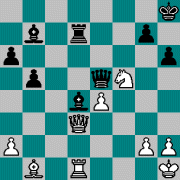
A miraculous finish from a recent game. White to play.

47.Kg2! Rh4 48.Bf2! Rh6 49.g5! fxg5
Now it’s your turn:

White to play and win?
Solution tomorrow
Solution to Christmas Eve Puzzle
For Christmas Eve, a Christmas Tree puzzle, with thanks to David Friedgood of the British Chess Problem Solving Society.
The puzzle was composed by T. R. Dawson and first published in the Chess Amateur in 1924.

The solution is as follows: If it were Black to move, then he would only be able to play 1…c3, met by 2.d4#, or 1…g3, met by 2.f4#.
But White to move can’t maintain the blockade and needs to progress by proactive means:
1.Ra3! (With the threat of 2.Ra5#, to which Black’ s sole defence is 1…e3) 1…e3 which allows the rook to return and deliver mate with 2.Rxe3#.
This symmetrical position poses the question of why the rook can’t play to the east rather than the west with the same effect, but you can work that out for yourself.
THE ULTIMATE BLUNDER
Last updated 20 November 1999.
Anyone can hang a piece, but a good blunder requires thought. There is one sort of move that is almost always played after calm, if not happy contemplation: resigning. Sometimes it is wrong to resign – or to agree to a draw. Recently in Dos Hermanas, Svidler took a draw against Anand when he had a forced win. Kasparov made both blunders within a few months in 1997, first resigning a game against Deep Blue that he could have drawn, then taking a draw against Lautier in a position that he could have won.
But those are blunders that only cost half a point – the ultimate blunder is when a player resigns in a winning position. It happens more often than you might think; in my ramblings through chess literature I have come across 35 examples. Click here to go to the first, and then click the diagrams to go to the next one.
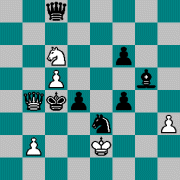
Best Chess Move Ever!
16…Nc6
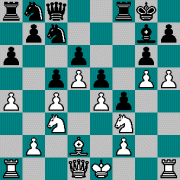 Averbakh – Spassky, Leningrad 1956
1.c4 Nf6 2.Nc3 g6 3.e4 d6 4.d4 Bg7 5.Be2 O-O 6.Bg5 c5 7.d5 Qa5 8.Bd2 a6 9.a4 e5 10.g4 Ne8 11.h4 f5 12.h5 f4 13.g5 Qd8 14.Bg4 Nc7 15.Bxc8 Qxc8 16.Nf3 Nc6 (About his #1 greatest move, Spassky wrote to me: I have played 16…Nc6 because I did not see any other practical resources because my position was so passive. I was very surprised that Yuri Averbakh was thinking about 1 hour (!!) (55 min.) I considered that after 17.dxc6 bxc6 18.h6! Bh8 White would have two pieces up and they could manage the win very easy. Mark Taimanov: “I would rather resign the game than to make such a move…”) 17.dxc6 bxc6 18.Nh4 Qe8 19.hxg6 hxg6 20.Qg4 Rb8 21.Nd1 Ne6 22.Ra3 Nd4 23.Rah3 Qf7 24.Bc3 Rfe8 25.R3h2 Qxc4 26.Nxg6 Re6 27.Bxd4 Rxg6 28.Qf5 Qe6 29.Qxe6+ Rxe6 30.Bc3 d5 31.f3 Rb3 32.Rh3 c4 33.Kd2 Rg6 34.Rg1 d4 35.Ba5 Bf8 36.Rg4 Rd6 37.Kc2 Rd7 38.g6 Rdb7 39.Be1 c5 40.Rgh4 Bg7 41.Ba5 c3 42.bxc3 Ra3 43.cxd4 exd4 44.Rxf4 Ra2+ 45.Kd3 Rb1 46.Rh1 Rxa4 47.Kc2 Rb5 48.e5 d3+ 49.Kxd3 Rxf4 50.Bc3 Rxf3+ 51.Ke4 Rg3 52.Kf4 Rxg6 53.Ne3 Rb8 54.Nf5 Rf8 55.Rh5 Re8 56.Ke4 Rg1 57.Rh3 Bf8 58.Kd5 Rd1+ 59.Ke4 Rc1 60.Kd5 Rd1+ 61.Ke4 Rd7 62.Nh6+ Bxh6 63.Rxh6 Rh7 64.Rg6+ Kf7 65.Rf6+ Ke7 66.Rc6 Kd7 67.Rxc5 Rh6 68.Kd5 Rb6 69.Ba5 Rb5 70.Rxb5 axb5 71.e6+ Rxe6 72.Kc5 Re5+ 73.Kb6 draw.
Diagram of the Century
Mate in 4 – Leonid Yarosh
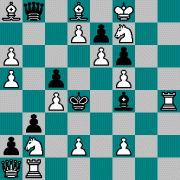 |
1st Prize Shakhmatyi v SSSR 1983
Mate in 4… – you may feel cheated that the ‘Diagram of the Century’ turns out to be a problem, the way I felt cheated when, as a boy, I went to a mouth organ club, and all the lessons turned out to be about Jesus.
You would, however, be cheating yourself if you left this page now.
If you don’t, you can go to the solution immediately. But there is, as one chess lover wrote, ‘profit and pleasure in the telling.’
Let’s try to follow the thoughts I might have had, had I tried to solve this problem myself.
What catches the eye immediately is the elegance of the position. It is far from gamelike but still, other than in most problems, it has patterns that are meaningful to the ordinary chessplayer.
Well, mate in 4. Let’s threaten something. 1.Re1 threatens 2.Re4 mate. Now 1…Qxa8 2.Rxf4+ would be mate next move, but with 1…Qxd8+ Black forces stalemate. Then maybe something like 1.Rg1, to threaten 2.Qe1 or Qf1? In that case again, after 1…Qxa8 2.Rxf4+ Qe4 3.R1g4 White mates in time, but once more, 1…Qxd8+ is enough to stave off the mate long enough.
Another obvious approach is to see what happens if we give a check. At first sight, that might seem to work: 1.Na4+ Kd3 2.Qc3+ Ke2 3.Qf3+ Kxd2 4.Qd1 mate, or 1.Nd1+ Kd3 2.Qc3+ Ke2 3.Bf3+ Kf1 3.Rh1 mate. But after both checks, Black can also capture on c4, winning a new flight square on b5, and then mate takes one move too many: 1…Kxc4 2.Qc3+ Kb5 3.Qxb3+ Kxa6 4.Bb7+ and mate next move.
Apart from that, both after 1.Na4+ and Nd1+, Black also has 1…b2. If then 2.Rxb2 Qxd8+ is clearly enough to stave off the mate long enough. 2.Qxb2+ is a better try, but after Qxb2 3.Nxb2 axb1=Q 4.Rxf4+ Qe4 5.Rxe4 it has again taken one move too many to deliver mate.
Of course, if any of these crude attempts had worked, Yarosh’ problem wouldn’t be the diagram of the century. But as always with problems, finding the right refutations will lead to finding the solution, and this last attempt teaches us something important. Why, in that variation 1.Na4(d1)+ b2 2.Qxb2+ Qxb2 3.Nxb2 axb1=Q 4.Rxf4+ Qe4 5.Rxe4 mate, was it mate at all, if too late? Because the black Queen no longer defended the Bf4. Indeed, without that Queen, it would be mate in 1 by 1.Rxf4. Then what if we tried to disturb the queen in controlling that square?
There is one obvious move to do that: 1.a7
Having a hunch that the thematic defence will be axb1=Q, we’ll try to cross off Black’s other possibilities first. He has two Queen moves that defend the mate without defending the Bf4, but after both White is in time: 1…Qxa8 2.Rxf4+ Qe4 3.a8=Q Qxf4 4.Qd5 mate. Or: 1…Qxd8+ 2.Kg7 and now 2…Qg8+ 3.Kxg8 and 4.d8=Q mate or 2…Qxa8 3.Rxf4+ Qe4 4.d8=Q mate or 2…Qc7 3.d8=Q+ Qxd8 4.Rxf4 mate.
So we turn to Queen moves that do defend Bf4. There are three, and against all three White is in time: 1…Qc7 2.Bxc7 axb1=Q 3.d8=Q mate, or 1…Qd6 2.Re1 Qe5 3.Nxe5 fxe5 4.Re4 mate or 1…Qe5 2.Bxe7 Qd6 3.Nxd6 Ke5 (otherwise Bxf6 mate) 4.Nd3 mate. This last variation, necessary for the soundness of the problem, demonstrates that luck is with geniuses.
Queen moves not working, Black turns to his most obvious defence: 1…axb1=Q White must then pursue his attack on the Bf4 by 2.axb8=Q Against the threat 3.R(Q)xf4 and mate, Black has two defences: 2…Qe4 and 2…Qxb2. After 2…Qe4, 3.R(Q)xf4 Qxf4 4.Q(R)xf4 is mate. 2…Qxb2 robs White of the control of two flight squares for the black king; c4 and d3. After 3.Qxf4+ Kd3 there is now no mate next move, but with 3.Qxb3 White regains control over c4 and d3, and as the Qb2 is pinned, it is mate next move by 4.Rxf4.
If this were all, it would still only be a mediocre and rather pointless problem, that wouldn’t even have been accepted by a serious problems magazine or column.
But it is not all.
There is almost a moral lesson here: we get access to beauty through the simple virtue of scrutiny. Have we really checked all of Black’s defences? After 1.a7, we checked all the Queen’s moves, and the promotion: axb1=Q What else could there be to check? Well, the promotion is the wrong wording: Black has four different promotions. But what good could a promotion to rook do him? Let’s just have a look: 1.a7 axb1=R 2.axb8=Q Now, there is no 2…Qe4, but Black still has his other defence: 1…Rxb2, making d3 and c4 available to his King. And if White now continues as before, with 3.Qxb3, it is stalemate. Aha.
Then what? We have to go back one move, to the position after 1.a7 axb1=R. White obviously must capture the black Queen. But if 2.axb8=Q does not work, what does work? It is at this point that the grandiosity of the whole thing might begin to dawn upon us. Suppose 2.axb8=R That still threatens Rxf4 mate, and after 2…Re1 White is in time with 3.Rxf4+ But after 2…Rxb2? Well, now, 3.Rxb3 is not stalemate, and after the only move, 3…Kxc4, 4.Qa4 is mate.
By now we can hardly believe or own thoughts. Could it really be that if Black defends by 1…axb1=B, White has to promote to a bishop too? Indeed, if now 2.axb8=Q, then Be4 3.Rxf4 or Qxf4 is stalemate. But after 2.axb8=B Be4, 3.Bxf4 is not stalemate. The black bishop can move, and must move, and after it does, 4.Be3 or Be5 is mate.
Finally: would 1…axb1=N make sense? It does, because after 2.axb8=Q Nxd2, Black again has access to a vital flight square, now c3, staving off mate long enough; after 3.Rxf4+ Ne4 there is no mate next move.
As stalemate is not an issue now, 2.axb8=R or axb8=B are pointless. The solution must be 2.axb8=N. But is it? Against the old threat of 3.Rxf4+, Black again defends with 2…Nxd2. And now, 3.Qc1 is still mate next move: after any knight move, 4.Rxf4 mate follows, except for 3…Ne4, when 4.Nc6 is mate. It was precisely for this one move that White needed a knight.
So:
If Black promotes to Queen, White must promote to Queen.
If Black promotes to Rook, White must promote to Rook.
If Black promotes to Bishop, White must promote to Bishop.
If Black promotes to Knight, White must promote to Knight.
This Holy Grail of chess had been searched for in vain for over a century. The greatest composers thought it would never be created.
Leonid Yarosh, when he composed this problem in 1983, was a 26-year old soccer trainer from Kazan, and a complete unknown in the composing world.
Here are the main variations of the solution recapitulated:
1.a7!
1…axb1=Q 2.axb8=Q Qxb2(!) 3.Qxb3 Qc3 4.Qxc3 mate
Qe4(!) 3.Qxf4 Qxf4 4.Rxf4 mate
1…axb1=R(!) 2.axb8=R! Rxb2(!)3.Rxb3 Kxc4 4.Qa4 mate
2.axb8=Q? Rxb2! 3.Qxb3 stalemate
1…axb1=B(!) 2.axb8=B! Be4(!) 3.Bxf4 B- 4.Be3(5) mate
2.axb8=Q? Be4! 3.Qxf4 stalemate
1…axb1=N(!) 2.axb8=N! Nxd2(!) 3.Qc1! Ne4 4.Nc6 mate
2.axb8=Q? Nxd2! 3.Qxf4+ Kc3 4.??
3.Rxf4+ Ne4 4.??
3.Qc1 Ne4 4.??
(c) Tim Krabbé, 1998
Forks without Knives!
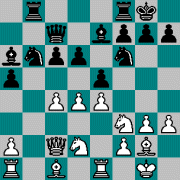 A funny case of a fork met by a counterfork: (See Diagram) White to play; Tretyakov – Zhuravlev, Riga 1978. White saw a fork which wins a pawn: 1.dxe5 dxe5 2.Qc3 But he didn’t see the counterfork: 2…Bb4 3.Qxe5 Qxe5 4.Nxe5 Bc3 which wins a piece.
Story of a chess player’s life

Club Championships Qualifers
Philip has confirmed that the results from the Club Championships Qualifers have been uploaded to the ICU Rating Officer. Expect to see the affects in the January Rating List?
2nd Greatest Chess Move
47…Bh3
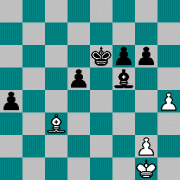 Topalov – Shirov, Linares 1998
1.d4 Nf6 2.c4 g6 3.Nc3 d5 4.cxd5 Nxd5 5.e4 Nxc3 6.bxc3 Bg7 7.Bb5+ c6 8.Ba4 O-O 9.Ne2 Nd7 10.O-O e5 11.f3 Qe7 12.Be3 Rd8 13.Qc2 Nb6 14.Bb3 Be6 15.Rad1 Nc4 16.Bc1 b5 17.f4 exd4 18.Nxd4 Bg4 19.Rde1 Qc5 20.Kh1 a5 21.h3 Bd7 22.a4 bxa4 23.Ba2 Be8 24.e5 Nb6 25.f5 Nd5 26.Bd2 Nb4 27.Qxa4 Nxa2 28.Qxa2 Bxe5 29.fxg6 hxg6 30.Bg5 Rd5 31.Re3 Qd6 32.Qe2 Bd7 33.c4 Bxd4 34.cxd5 Bxe3 35.Qxe3 Re8 36.Qc3 Qxd5 37.Bh6 Re5 38.Rf3 Qc5 39.Qa1 Bf5 40.Re3 f6 41.Rxe5 Qxe5 42.Qa2+ Qd5 43.Qxd5+ cxd5 44.Bd2 a4 45.Bc3 Kf7 46.h4 Ke6 47.Kg1 Bh3 48.gxh3 Kf5 49.Kf2 Ke4 50.Bxf6 d4 51.Be7 Kd3 52.Bc5 Kc4 53.Be7 Kb3 and White resigned

